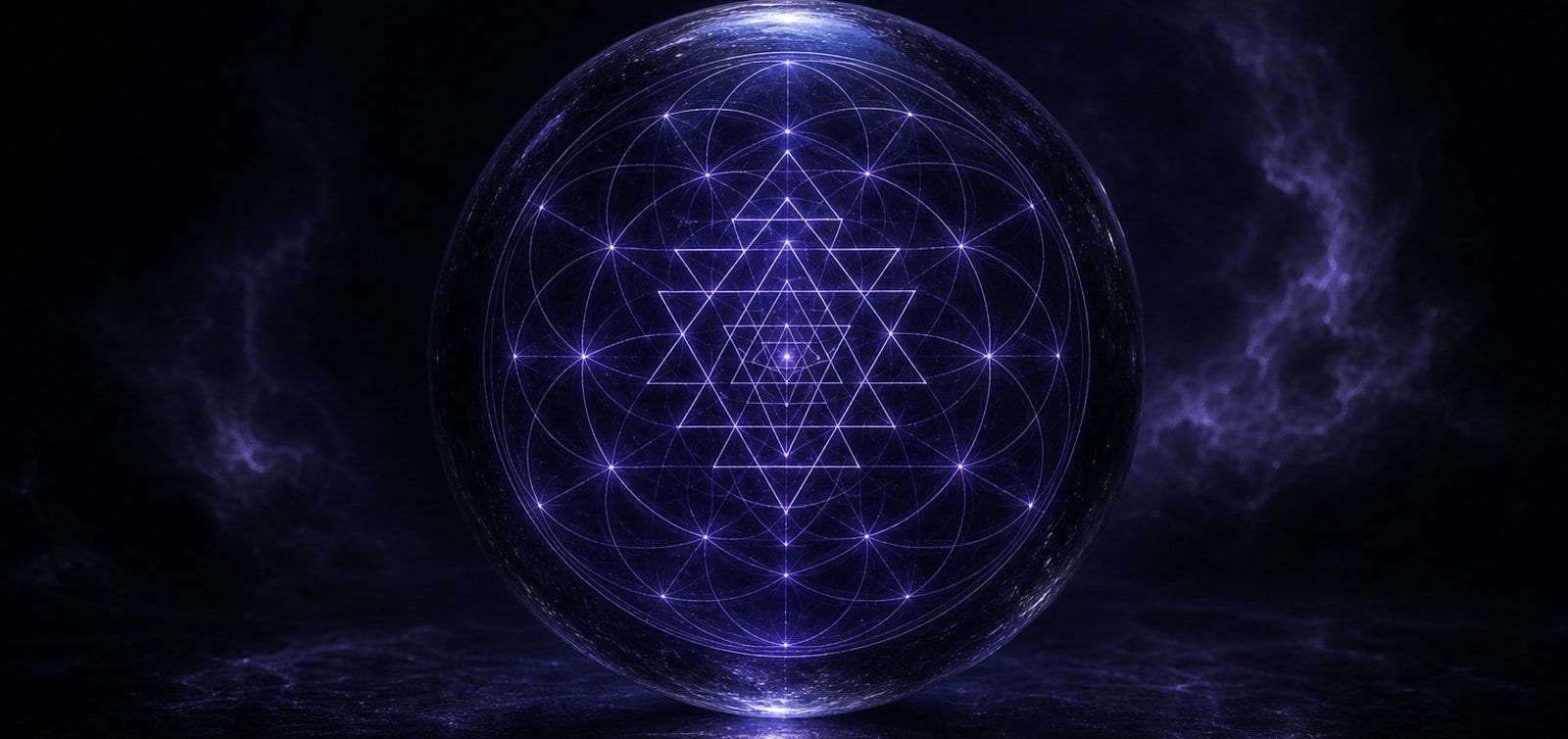
You have seen these patterns before. Circles overlapping into a six-petalled flower on a temple wall in Egypt. Nested triangles converging on a single point in a Himalayan shrine. Thirteen circles joined by every possible line, drawn in the margins of a Renaissance notebook. Different centuries, different continents, different gods. The same geometry.
That repetition is not a coincidence, and it is not a conspiracy. It is evidence of something simpler and more interesting: certain visual structures do something to the human mind, and every contemplative culture that discovered them kept them.
This is a guide to what sacred geometry actually is, where it comes from, why it works as an anchor for meditation, and how to begin a sacred geometry practice that takes minutes a day.
What Is Sacred Geometry?
Sacred geometry is the study of proportions and patterns that recur throughout nature and, for thousands of years, throughout human art and architecture. The honeycomb's hexagons. The spiral of a nautilus shell. The branching ratios of trees and rivers and lungs. The same handful of forms keeps surfacing, from the microscopic to the cosmic, and ancient builders treated that recurrence as meaningful. They designed temples, cathedrals, mandalas, and yantras around it.
You do not need to take a mystical view to find this remarkable. Mathematicians see recurring solutions to physical constraints. Contemplatives see the signature of order beneath appearance. Both are looking at the same shapes, and both traditions arrived at the same conclusion in practice: these patterns reward sustained attention.
That is the core of it. Sacred geometry is geometry that people have found worth gazing at, tracing, and building around for five thousand years. Not decoration. A tool.
A History Written in Stone
The oldest known flower of life patterns were incised into the granite of the Osirion at Abydos, Egypt. Islamic artisans, working under a tradition that discouraged figurative art, developed geometric tiling into perhaps the most sophisticated pattern language ever created; the Alhambra is a meditation hall disguised as a palace. Gothic masons encoded ratio and rose windows into cathedrals designed to tilt the visitor's mind upward.
In India, the yantra tradition refined geometry into instruments. A yantra is not a picture of something. It is a diagram built to hold the eye and structure contemplation, the visual equivalent of a mantra. The Sri Yantra, its most famous form, has been in continuous devotional use for over a thousand years.
Tibetan Buddhism built the mandala: concentric geometry representing the cosmos, constructed grain by grain in coloured sand and then swept away, the practice being the point. Carl Jung later borrowed the word, observing that patients drawing mandala forms seemed to be reaching for psychological order during difficult periods.
Across all of these traditions the pattern is the same. Geometry was never merely admired. It was used.
Three Patterns Worth Knowing
The Flower of Life. Overlapping circles of equal size, each centred on the intersections of its neighbours, blooming outward into a hexagonal field. It is a picture of one process repeated without ego: every circle identical, every circle sharing its centre with others. Within its lattice you can find the seed of life, the vesica piscis, and the scaffolding for all five Platonic solids.
Metatron's Cube. Take thirteen circles from the flower of life and connect every centre to every other centre. The resulting figure contains the outlines of all five Platonic solids, the shapes Plato associated with the elements themselves. Where the flower feels organic, Metatron's cube feels crystalline: a diagram of total connection, nothing isolated, everything joined.
The Sri Yantra. Nine interlocking triangles, four pointing up and five pointing down, arranged around a central point called the bindu. The interlock is so precise that constructing it correctly occupied mathematicians well into the twentieth century. In practice, the eye is drawn through layer after layer toward the still centre. It is a map of attention itself: wide at the rim, single-pointed at the heart.
Why Geometry Calms the Mind
Meditation traditions discovered by experiment what attention research is now measuring: the mind settles faster when it has something structured to rest on.
Focused-attention meditation, the kind most beginners are taught, needs an anchor. Usually that anchor is the breath. A visual anchor works the same way, and symmetric, self-similar patterns turn out to be unusually good ones. Studies of fractal and symmetric imagery consistently find that people process these patterns more fluently than visual noise, and rate them as more restful. Researchers studying natural environments call the effect soft fascination: stimuli rich enough to hold attention effortlessly, calm enough not to seize it. A rose window holds the eye the way a campfire does.
There is also the matter of what geometry does not contain. No faces, no words, no story. Nothing to evaluate or compare yourself against. Modern visual life is almost entirely social signal; a yantra is attention with the social channel switched off. Tracing a pattern with your gaze while your breath slows is a two-channel practice, occupying exactly enough of the mind that the usual commentary has nowhere to run.
None of this requires belief. The geometry works on the same nervous system whether you consider it sacred or simply beautiful.
How to Practise: A Simple Method
You can begin tonight, with nothing but an image and five minutes.
- Choose one pattern. Flower of life for softness, Sri Yantra for depth, Metatron's cube for structure. Do not rotate between them in one sitting.
- Set a container. Five minutes is enough. A practice you repeat daily beats a long session you repeat never.
- Rest your gaze at the centre. Let the eyes stay soft, almost unfocused. The pattern's symmetry will hold your attention without effort.
- Pair it with slow breath. In for four counts, out for six. Let the exhale be longer than the inhale; that ratio slows the heart.
- When the mind wanders, return to the centre. The bindu, the middle circle, the innermost triangle. That return is the entire exercise. Every return is a repetition, and the repetitions are what change you.
That is a complete sacred geometry meditation. Everything else is refinement.
Where Orb Comes In
We built Orb around a simple observation: this practice is ancient, but nothing modern presents it well. Static images do not breathe. Videos demand a feed. Most meditation apps bury a mandala somewhere behind a subscription and a streak counter.
In Orb, the geometry is alive. The flower of life, Metatron's cube, and the Sri Yantra render in real time on the surface of your personal orb, drawn in light, turning slowly, responding to the pace of your breath. Six layered practices are built on them: Flower of Life Breath, Metatron Focus, Sri Yantra Balance, Theta Drift, Alpha Stillness, and Lucid Gateway. Each one pairs a pattern with a breathing rhythm and a frequency layer, and each takes minutes, not hours.
There is no feed underneath it. No streaks, no leaderboard, no infinite library engineered to keep you browsing. One purchase, and the practices are yours forever, on iPhone and Mac. Orb is designed around a single daily moment of stillness, and the geometry is there to give that moment a centre.
Begin With One Pattern
Five thousand years of temple builders, geometers, and contemplatives kept returning to the same shapes for one reason: they work. A circle of overlapping circles can do what an hour of willpower cannot, which is to give your attention somewhere quiet to stand.
Choose one pattern. Give it five minutes. Watch what your mind does when it finally has something still to look at.
Download Orb for iPhone and Mac and begin your first sacred geometry practice today.